Investment decision · UK businesses
Three ways to fund it, and the point where each one stops.
A larger investment comes down to a choice between ways of paying, set against doing nothing. I work that choice out after tax and in writing, so you can take it to your board and your bank.
- Ways to fundown cash, hire purchase and lease, each set against doing nothing
- After taxcapital allowances and Corporation Tax at the rates that apply now
- Tipping pointsthe volume and the rate at which each way stops paying
- Scope firstagreed in writing before you share a single figure
01For whom
Owners facing a decision that sets the next years
This is for owner-managed businesses in the UK with total assets of about £4m or more. The decision in front of you is large enough to change the balance sheet. It might be a new line, a second site or the replacement of a central machine.
You already have quotes and a view of your own. What is missing is a written comparison that a board, a co-owner or a lender can follow without you in the room.
02What you get
A decision note with the answer on page one
The first page gives the recommendation and the condition under which it holds. The pages behind it show how I got there.
- Each way of funding set against doing nothingnet present value after tax, with the range across your order scenarios
- The point at which each option stops payingin sold hours, in interest rate or in whatever drives your case
- What it costs to wait, and what it would be worth to know more firstso you can tell whether a delay buys anything
- Every assumption listed with its basisyour figures, public rates and tax rules, each one dated
A worked example
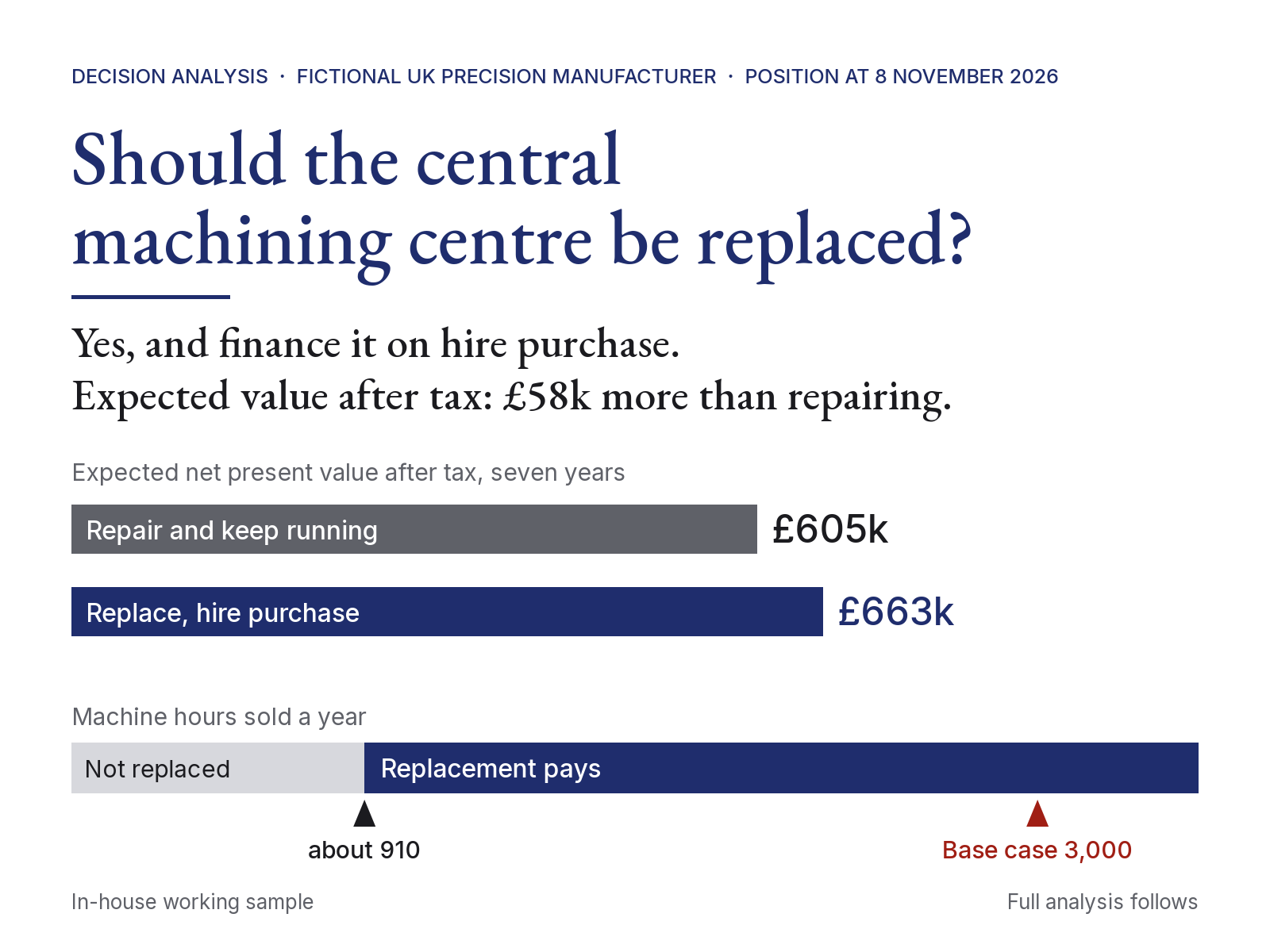
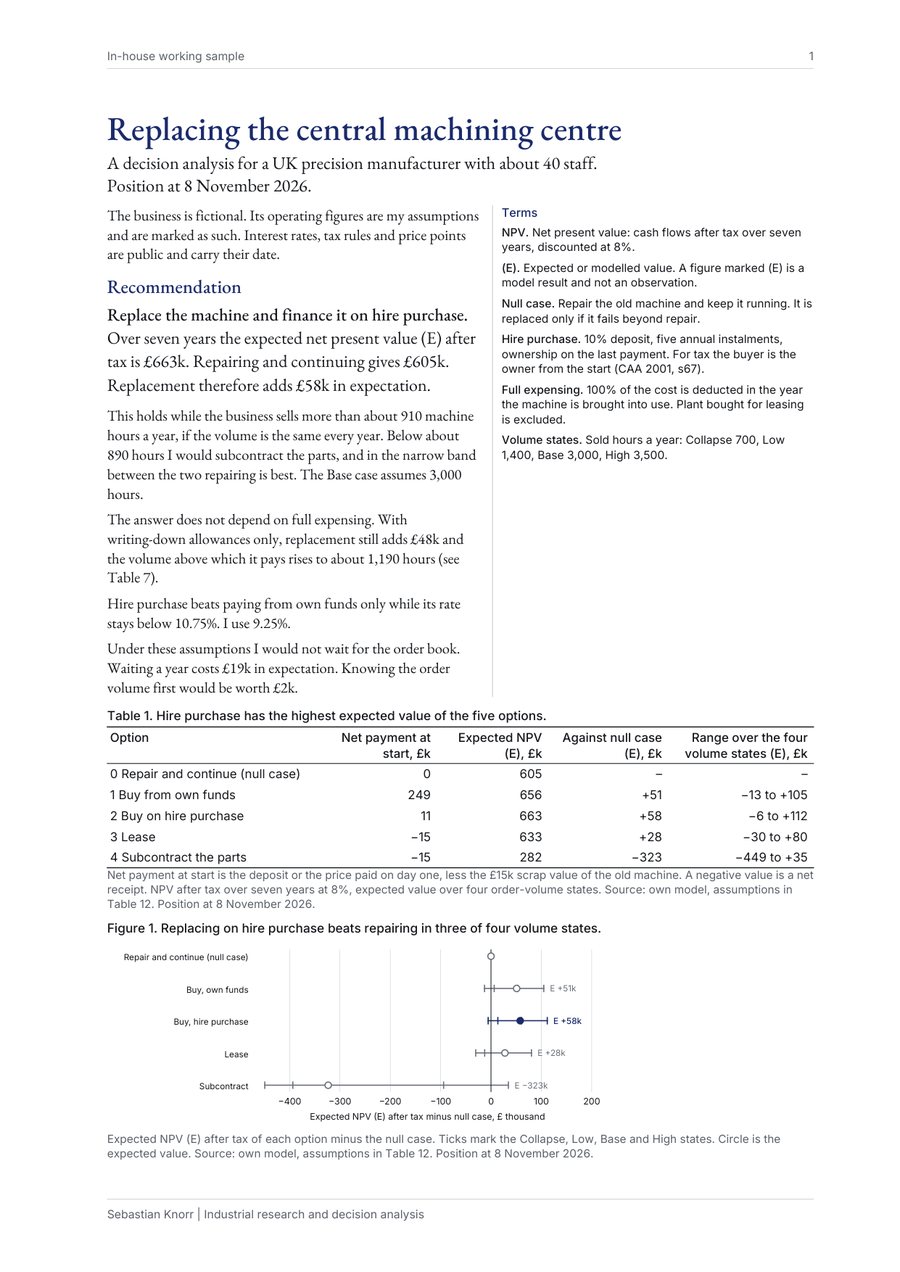
A precision manufacturer with about 40 staff has to replace its central machining centre. The note compares repair, buying from own funds, hire purchase, lease and subcontracting the parts.
Replacing the machine on hire purchase adds £58k in expectation over seven years, compared with repairing it. That holds while the business sells more than about 910 machine hours a year. Hire purchase beats paying from own funds while its rate stays below 10.75%.
The company and its operating figures are invented and marked as my assumptions. In your note they are your own figures.
Open the example PDF, 10 pages, 165 KB03How we start
Scope first, figures second
You share nothing confidential until we have agreed in writing what the note will answer. The price is fixed and stands in that agreement.
- 1
You describe the decision.
A few sentences by e‑mail on what you plan and roughly what it costs. No figures are needed yet.
- 2
We agree the scope in writing.
The question, the options, the inputs I need from you, the date and the fixed price.
- 3
I sign a confidentiality agreement if you wish.
Before any management accounts or quotes change hands.
- 4
You receive the note on the agreed date.
Questions that come up afterwards I answer in writing.
04Write to me
Which decision is on your desk?
Reply to my e-mail or write to the address below. I answer in person, by the next working day.
kontakt@sebastian-knorr.comThe note sets out a decision on stated assumptions. It is not a credit opinion. Your accountant and your lender keep the last word.